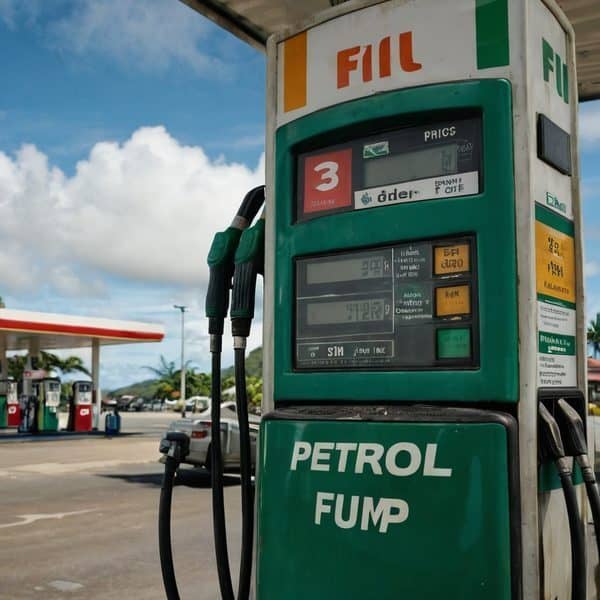
Prime Minister Sitiveni Rabuka has unveiled a FJ$56 million (US$39.95 million) government package to ease the impact of sharp fuel price rises, while stressing that Fiji’s supply remains secure despite mounting global cost pressures. Rabuka announced the measures on April 21 and provided fresh stock and delivery figures to reassure a public already feeling the squeeze at the pump.
“As of the 19th of April 2026, Fiji’s fuel supply remains stable,” Rabuka said, outlining that about 45 million litres of fuel are currently on land and an additional 22 million litres are expected before the end of April. That brings April’s total available supply to roughly 67 million litres — close to half of national storage capacity — with daily consumption running at about 2.5 million litres. He warned stocks will decline as part of the normal cycle, projecting reserves to fall to about 40 million litres, or 29 percent of capacity, by month’s end.
Rabuka said the deeper concern is price, not availability. He blamed a global crisis tied to conflict in the Middle East — including disruptions linked to the closure of the Strait of Hormuz — for pushing up international fuel prices. “This is not a fuel shortage crisis. This is a global price crisis,” he said, noting that fuel is bought in US dollars and higher global purchase costs are passed through to the domestic market. The Fijian Competition and Consumer Commission (FCCC), the independent price regulator, determined the last domestic price increase that took effect on April 1, and another rise is anticipated in May if global rates remain elevated.
The government response approved by Cabinet on April 21 is a redeployment of existing 2025–2026 Budget funds rather than new borrowing. Rabuka said the FJ$56 million will be redirected from delayed projects to provide “immediate support where it is needed most,” with a focus on protecting livelihoods, maintaining essential services and supporting vulnerable households, businesses and transport operators affected by higher fuel costs.
Looking ahead, Rabuka said suppliers have committed to deliver around 118 million litres in May, which should push national fuel stocks back up to more than 59 percent of storage capacity and restore what he described as a “stable supply position.” He characterised Fiji’s status as Phase 1 — normal supply but under pressure from high global prices — and urged calm as the country awaits the larger May shipments.
The announcement follows regional and domestic warnings over the past month about the risks to fuel markets from rising geopolitical tensions. In March, officials and analysts cautioned that disruptions around the Strait of Hormuz could sharply raise international crude and refined fuel costs — a threat to Fiji and other Pacific nations that import all of their fuel. Rabuka’s briefing gives the clearest public accounting yet of stock levels, consumption rates and the government’s short-term fiscal response, even as consumers brace for further retail price increases if global markets do not stabilise.
Leave a comment