Prime Minister Sitiveni Rabuka has moved to reassure Fijians that the country has sufficient fuel supplies even as households and businesses brace for higher prices, announcing a FJ$56 million (US$39.95 million) government redeployment to cushion the impact of a global fuel price spike. Rabuka told the nation on Friday that the measures, approved by Cabinet on April 21, come from reprioritised funds within the existing 2025–2026 budget and do not require new borrowing.
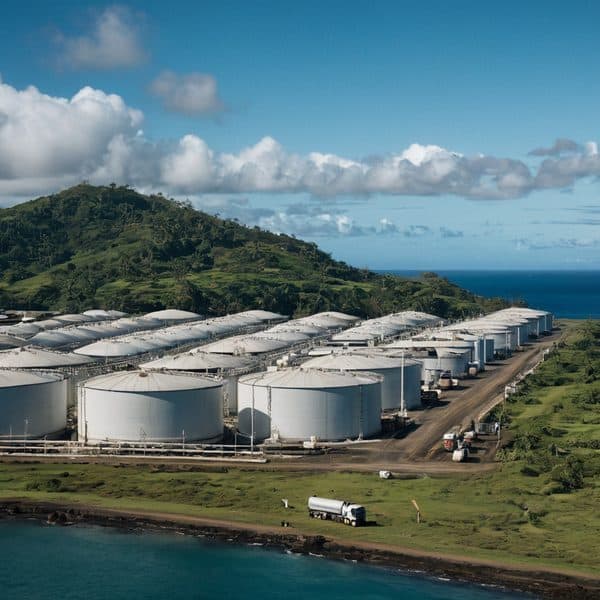
Giving the latest stock update, Rabuka said that as of April 19 Fiji had about 45 million litres of fuel on land with a further 22 million litres expected to arrive before the end of April, bringing total April availability to roughly 67 million litres — close to half of national storage capacity. Daily consumption is running at about 2.5 million litres; under normal drawdown patterns, officials expect stocks to fall to about 40 million litres, or roughly 29 percent of capacity, by month’s end as terminals are cleared to receive incoming shipments.
Rabuka warned that the current pressure is on prices rather than supply. He described the situation as a “global price crisis” linked to the war in the Middle East and shipping disruptions tied to the Strait of Hormuz. Because Fiji purchases fuel in US dollars, spikes in international crude and freight costs feed quickly into local pump prices, he said. The independent price regulator, the Fijian Competition and Consumer Commission (FCCC), increased retail rates on April 1 to reflect real purchasing costs; Rabuka said another adjustment is expected in May.
The government’s FJ$56 million package is intended to shield families, transport operators and essential services from the immediate effects of higher fuel costs. Rabuka framed the move as a short-term intervention—delaying selected projects and redeploying those funds to provide relief—rather than longer-term subsidy spending. He said the aim is to “protect livelihoods, maintain essential services and support those most affected” while the country weathers the external shock.
On supply prospects, Rabuka said fuel suppliers have committed to deliver about 118 million litres in May. Those shipments, once discharged, are expected to push national stocks back up to more than 59 percent of storage capacity, restoring a more comfortable buffer. “This means Fiji remains in a stable supply position. There is no shortage. We are currently operating in Phase 1 — a normal supply situation, but under pressure from high global fuel prices,” he said.
The prime minister’s briefing follows months of regional concern and earlier warnings that tensions in the Middle East could push up global oil prices and disrupt shipping routes, a theme reported in March. For consumers and businesses, the immediate consequence is higher domestic fuel bills and the knock-on effect on transport and goods prices, a central reason the government has moved quickly to reallocate budget resources rather than increase public debt.
Rabuka’s update provides a clearer short-term picture — confirmed stock figures and a large May delivery pipeline — even as it signals tougher months ahead on costs. With another FCCC price review due, the government’s redeployment is positioned as a bridging measure to mitigate hardship while markets and supply schedules stabilise.
Leave a comment