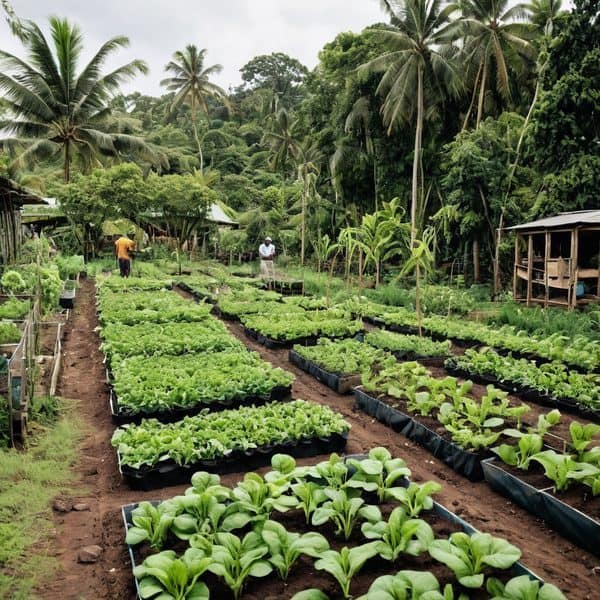
The Fijian government has stepped up its response to growing food security and cost-of-living pressures by launching a farm recovery program and a national home-gardening drive after Tropical Cyclone Vaianu and mounting global shocks exposed vulnerabilities in local food production. New figures cited by authorities show roughly 258,000 people — out of a national population of about 900,000 — are living below the poverty line, underscoring the urgency of measures to shore up household food supplies.
Tropical Cyclone Vaianu inflicted an estimated $1.5 million in agricultural losses across key farming areas, with more than 66.7 percent of those losses occurring in the crop sector. Officials say affected commodities included staple root crops and fruits such as tavioka and pawpaw, bananas and plantains, yaqona, and export vegetables — crops vital both for domestic consumption and livelihoods. The government’s recovery package is being prioritised for communities where these losses were heaviest.
As part of the response, the Ministry of Agriculture is rolling out a targeted rehabilitation program in Kadavu, Ba, Ra, Nadroga/Navosa and Naitasiri. Affected families will receive seedlings, planting materials, agro-inputs and technical advice aimed at quickly restoring production and household incomes. The recovery work is being delivered alongside a broader food security response that also addresses pressures stemming from the global conflict and intermittent fuel shortages that have pushed up transport and input costs.
Complementing the recovery program is the Scaling-Up Home Gardening Initiative, promoted under the theme “From Our Backyards to Our Plates: Grow What You Eat, Beat Rising Prices.” The initiative encourages households to set up small productive plots — even in urban yards — growing rourou, beans, cabbages and other quick-return vegetables to reduce grocery bills and build a buffer against future price spikes or supply disruptions. Government messaging stresses that while backyard gardens are not a panacea for national food system challenges, they can strengthen resilience at the household level.
The campaign arrives as many families are already adapting their food and fuel habits. Colleague Waisale, who lives in Suva with one son while his wife and young children attend school on Kadavu, says his family has turned to firewood for daily cooking to reduce costs and is teaching his children to slow-cook traditional dishes. He also plants bele, rourou, dhania, tubua and long beans and participates in communal harvesting with church members. Another colleague, Harold, said rising prices have led his household to buy fish more often than chicken and to maintain a backyard plot of green leafy vegetables and tavioka to stretch their fortnightly grocery budget.
Officials frame the initiatives as immediate, practical actions to protect vulnerable households while broader economic pressures are addressed. The Household Income and Expenditure Survey figures showing more than a quarter of Fiji’s population below the poverty line have driven the government’s emphasis on both rehabilitating commercial farms damaged by Vaianu and scaling up small-scale food production at home to mitigate the impacts of inflation and supply shocks.
Leave a comment