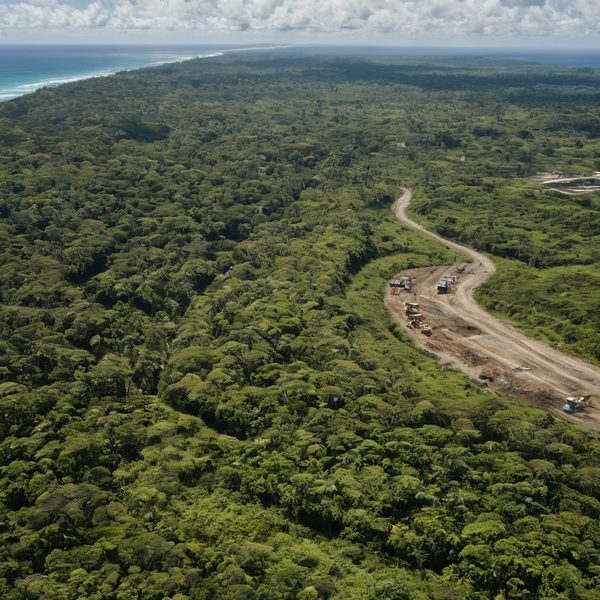
A new report says the rapid expansion of U.S. military activity in Palau has outpaced legal and environmental safeguards, leaving communities and local authorities sidelined and prompting legal action and fresh diplomatic attention for the Pacific nation.
Published by the Guam-based Pacific Centre for Island Security on April 13, 2026, the Micronesia Security Outlook 2025 includes a Palau chapter authored by Jodean Remengesau, director of the Bureau of Agriculture at Palau’s Ministry of Agriculture, Fisheries and the Environment. Remengesau argues that the Compact of Free Association, which grants the United States broad access to Palauan land, waters and airspace while requiring environmental protections, has not been fully observed as U.S. military infrastructure has been accelerated across the islands.
The report singles out the clearing of 271,807 square metres of land on Angaur for a tactical mobile over-the-horizon radar site as a specific case in which Palauan environmental laws were allegedly bypassed. Remengesau wrote that the U.S. military did not obtain an earthmoving permit or conduct community consultations, and that shredded tree debris from the clearing — which posed a risk of invasive coconut rhinoceros beetle infestation — was later dumped on residents’ yards in a “rushed effort” to address the problem. In 2023 Angaur Governor Steven Salii filed a lawsuit naming Palau’s central government, the Palau Environmental Quality Protection Board, the U.S. government and its military contractors, alleging violations of Palauan environmental legislation and compact obligations over the land disturbance.
The timing of the report coincides with other high-profile developments. Under a renegotiated Compact of Free Association that took effect on October 1, 2023, the United States pledged an US$890 million assistance package to Palau over 20 years, and pledged to provide for Palau’s defence. The report notes that compact funds now make up a significant portion of Palau’s national budget, a reality that shapes the island nation’s options as regional geopolitical tensions between the United States and China intensify.
Military hardware is also moving closer to full operation. The report highlights a US$118 million radar project that the U.S. military has been developing in Palau and says it is expected to be operational this year. Remengesau and the Pacific Centre’s analysis caution that installations initially presented as joint or mutual-use infrastructure have in some cases evolved into more extensive U.S. military facilities than originally described, amplifying concerns about oversight and local consent.
The report’s findings arrive as Palauan president Surangel Whipps Jr. this week made the country’s first-ever state visit to New Zealand — a diplomatic milestone underscoring Palau’s heightened international profile amid security and environmental disputes. The visit, observers say, reflects growing regional and international attention on how small Pacific states navigate the competing pressures of strategic partnerships and domestic environmental governance.
Palauan officials, U.S. authorities and military contractors have not released a coordinated public response to the Pacific Centre report. The publication is likely to sharpen calls from island leaders and civil society for clearer enforcement of environmental safeguards under the compact, greater transparency on military projects, and stronger consultation with affected communities as Palau’s role in regional security deepens.
Leave a comment