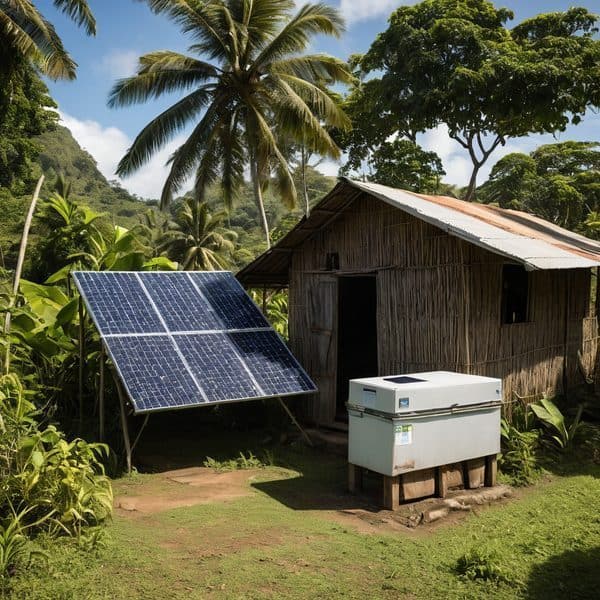
A $10,150 solar-generated freezer has been installed in the village of Navatu, Kubulau, in Bua, offering immediate relief to a fishing community long hampered by limited storage and unreliable transport that forced catches to be sold or eaten the same day.
Village headman Viliame Ramesiwa said the absence of cold storage had constrained the community’s ability to preserve seafood and to seek better prices at market. “Previously, whenever we went out fishing, our catches had to be sold on the same day,” he said, describing times when unavailability of transport left families with no option but to consume the catch or see it go to waste. “The solar freezer is a weight off our shoulders in terms of generating income.”
The project — described by locals as a solar-generated freezer valued at $10,150 — will serve 31 households across Navatu, including men and women fishers, elders and schoolchildren, Ramesiwa said. With storage now available on site, villagers expect to hold seafood until transport and market conditions are favourable, preserving quality and avoiding the sharp income losses that followed spoilage or forced cut-price sales.
Solar-powered cold storage is particularly suited to remote maritime communities such as Navatu, where grid electricity is often unavailable or unreliable. By running on sunlight, the freezer removes dependence on costly fuel-powered generators and ice purchases, factors that previously made preserving a catch economically impractical for many households.
Community leaders welcomed the assistance as more than a convenience. Ramesiwa said the facility will help stabilise household incomes and could enable households to plan fishing trips more strategically rather than being driven by immediate disposal needs. “We are grateful for such assistance because it benefits the whole village,” he said.
The Navatu installation comes amid a broader regional focus on low-carbon, climate-resilient projects that support livelihoods in remote Pacific communities. Development partners and governments across the Pacific have been promoting renewable-energy solutions and blue-economy initiatives to bolster food security and economic opportunities in coastal settlements.
For Navatu, the new freezer will be an early test of how small-scale renewable infrastructure can change the economics of subsistence and small-scale commercial fishing. Village leaders will now face the practical tasks of managing access, scheduling use, and maintaining the unit — challenges communities commonly navigate as they translate new assets into sustained income gains.
Leave a comment