
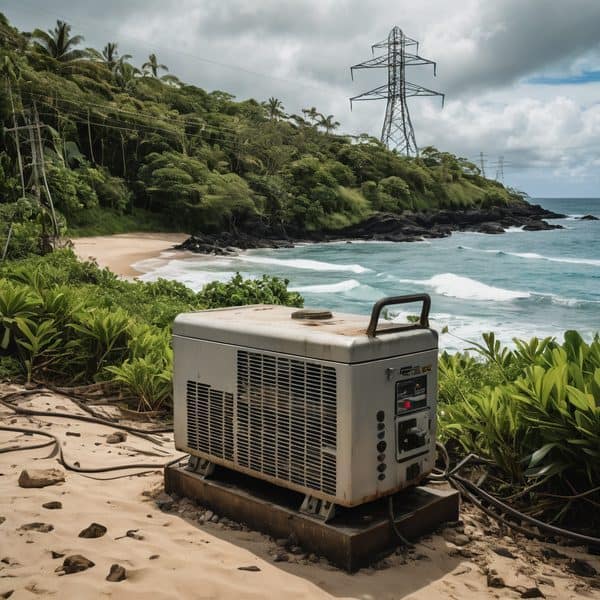
Tuvalu’s fortnight-long State of Emergency will be lifted on Monday, but the government says it is still racing to shore up the country’s power system while longer-term replacements are secured. In a fresh update on 27 April, Transport and Energy Minister Simon Kofe confirmed a rented generator funded by the Asian Development Bank will arrive on 28 May to provide interim backup, while procurement for permanent units is due to begin in early May.
Kofe said electricity supply across Funafuti and other islands is “stable” and that recent blackouts have been caused by network faults rather than generator failures. The ADB-funded rental unit is expected to remain for three to six months as new generators are ordered and commissioned. Fuel stocks are currently steady, he added, with the next tanker shipment scheduled for 13 May — a key date for ensuring supply while storage and distribution improvements are completed.
Technical fixes and international assistance form a central part of the update. Kofe reported that solar integration has improved after engineers resolved a faulty communication cable to the battery system, allowing existing solar capacity to more effectively support generation. Work is also under way to address compatibility problems between newer renewable systems and older diesel generators so the hybrid grid can operate more reliably.
International partners are stepping in to plug capability gaps. Japan is exploring support to send a Daihatsu specialist to assist with maintenance of TEC’s existing generator fleet, while Australia will deploy technical advisers to strengthen the financial systems and accounts at the Tuvalu Electricity Corporation (TEC). The Public Works Department and national ICT teams are coordinating with TEC to reinforce infrastructure and system security, Kofe said.
Social support measures have also been launched. The Department of Energy, together with the Red Cross, is conducting a household survey to identify vulnerable families eligible for hardship assistance during and after the emergency period. Authorities say this targeting is intended to ensure those most affected by outages and fuel shocks receive timely relief as recovery moves from an emergency footing to longer-term resilience work.
Officials emphasised that gaps remain despite improvements: procurement is scheduled to begin in early May but permanent replacements will take time to arrive and be installed, leaving a reliance on rental capacity and careful fuel management in the interim. Preparations to expand fuel storage capacity are being advanced with Australian support to reduce the risk of future supply disruptions.
In a separate regional development, Palau has mourned the death of former leader and business pioneer Surangel Whipps Senior, who passed away at the age of 86. His death was listed among the Pacific news items alongside Tuvalu’s energy update.