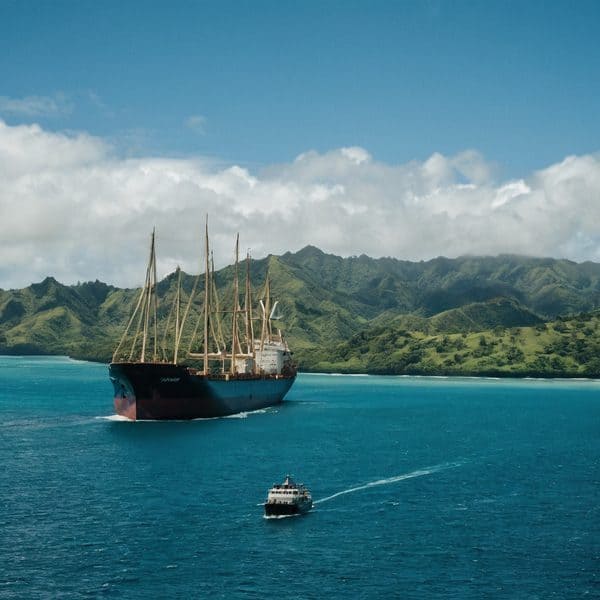
PACIFIC ISLANDS — Pacific shipping, a lifeline for isolated island communities, is at a crossroads as regional experts urge a rapid transition to wind-assisted and other low-carbon technologies to blunt rising fuel costs, ageing fleets and climate vulnerability.
Speaking at a regional discussion on low‑carbon maritime transport, Natasha Chan, assistant legal researcher for the Micronesian Centre for Sustainable Transport, warned that delayed or unreliable shipping can mean “empty store shelves, fuel shortages and isolation” for communities that depend on sea links. Chan said the Pacific faces some of the highest maritime connectivity costs globally, with long distances between small ports, inadequate domestic services on unprofitable routes and a dependence on old or donated vessels maintained by weak systems and limited insurance capacity.
Researchers and practitioners at the forum highlighted two practical findings. First, historical trials in the Pacific during the 1980s fuel crisis showed wind‑assisted propulsion systems — using sails or modern equivalents — delivered fuel savings of roughly 30 percent. Second, more recent research cited by Chan suggests that, with appropriate application of mature technologies and tailored financing, fuel savings of at least 40 percent are attainable today across Pacific operations. Chan cautioned that international market leaders cannot simply be scaled down without Pacific‑specific research and development: “It is not a case of simply taking international market leaders and scaling them down.”
The renewed emphasis on wind‑assistance arrives amid a broader push to strengthen maritime governance and climate resilience in the region. The International Maritime Organization’s Regional Presence Office in Suva, established last year, was cited in prior reporting as a platform intended to provide technical expertise and coordination on decarbonisation, maritime safety and law reform — functions that could prove critical if Pacific nations are to adopt and finance vessel retrofits and new designs suited to local routes and economies.
The shipping debate comes as multiple parallel developments highlight the urgency of resilient sea links. Fiji’s Climate Change Minister has recently set priorities to accelerate Pacific climate action, and the Weather Ready Pacific initiative is strengthening early warning systems for communities — steps that underscore the region’s vulnerability to extreme weather and supply disruptions. At the same time, the University of the South Pacific has doubled student support amid a global crisis, and Vanuatu’s Prime Minister Ishmael Kalsakau (PM Napat) launched Emua Vila, the country’s first economic micro‑hub, signalling efforts to diversify and localise economic activity.
Security, health and economic pressures also frame the maritime challenge. Timor‑Leste President José Ramos‑Horta warned this week that his country is vulnerable to “infiltration by foreign organised crime,” a concern that could have implications for maritime governance and port security across the Pacific. The Solomon Islands’ Gizo hospital has declared a state of emergency, and Papua New Guinea’s health minister praised a visiting Chinese medical ship — reminders that sea transport underpins health and humanitarian responses. In Fiji, opposition voices are warning that rising fuel prices will severely affect workers’ livelihoods, intensifying calls for cost‑reducing measures in shipping.
Experts say the pathway ahead will require coordinated finance, insurance reforms and targeted R&D to adapt wind‑assisted systems and other low‑carbon options to the small, dispersed vessels common in the Pacific. If matched with investment and regional cooperation, advocates argue, wider uptake of wind propulsion and complementary technologies could both cut operating costs substantially and reduce the carbon footprint of a sector central to island economies and resilience.
Leave a comment