
The New Zealand Defence Force has destroyed two World War II-era bombs found on Bougainville, carrying out in-place detonations at Aropa Airfield and at Koeta Primary School after being asked to assist by the Autonomous Bougainville Government.
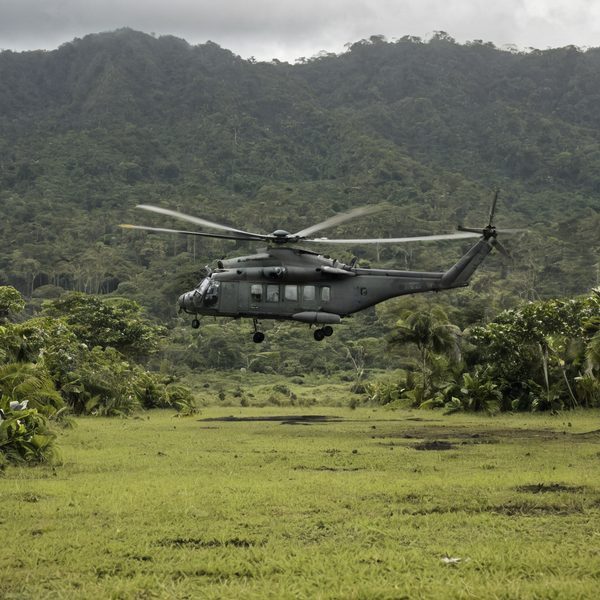
Specialist NZDF explosive ordnance disposal personnel were transported to the region on a Royal New Zealand Air Force C-130J Hercules before moving to the Aropa site aboard an NH90 helicopter from No.3 Squadron. The NH90 and its crew had been in neighbouring Papua New Guinea delivering aid to communities affected by Tropical Cyclone Maila when they were tasked to support the clearance operations on Bougainville.
Reconnaissance by the specialist team determined that both devices were too unstable to be moved safely, so they were destroyed where they lay. Standard safety measures were put in place at each site: sandbags were positioned around the ordnance to help contain the blast, and large exclusion cordons were established to keep people at a safe distance during disposal operations.
The locations — an airstrip and a primary school — underscored the potential danger the unexploded munitions posed to local communities. The Autonomous Bougainville Government made the formal request for New Zealand support to dispose of the ordnance, citing the risk to residents and to critical infrastructure.
Unexploded World War II munitions remain a legacy hazard across parts of the Pacific, and their safe disposal typically requires specialist teams and equipment. The NZDF deployment to Bougainville demonstrates the use of military airlift and rotary assets not only for disaster response — as was the case with the NH90 crew’s prior mission in PNG — but also for targeted explosive ordnance disposal when requested by local authorities.
The NZDF has not released further operational details about the detonations. Local officials on Bougainville and the Autonomous Bougainville Government coordinated the request and perimeter security for the disposals, according to a briefing on the operation. Any further UXO discovered in the region is likely to prompt additional requests for specialist assistance given the hazards such devices present in populated areas.