
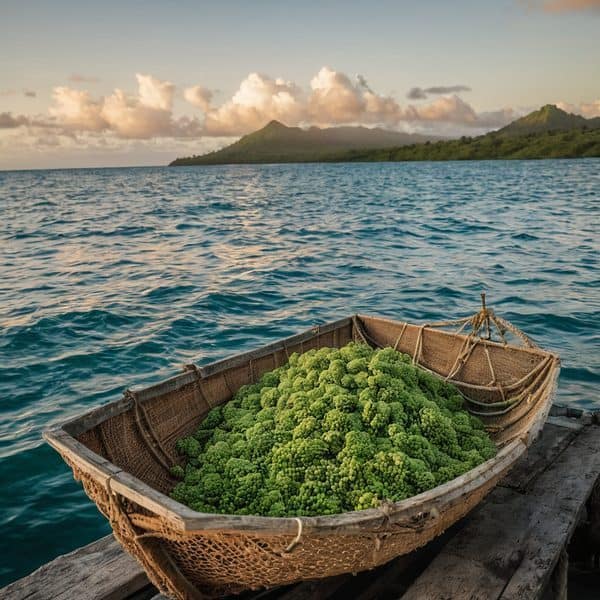
In the sunlit coastal village of Namuaimada in Ra, a group of about 40 local women have quietly turned a fragile ocean crop into the backbone of their community’s economy. Once a seasonal delicacy, edible sea grapes known locally as nama are now the primary livelihood for many households, harvested from reef beds at Cakau Levu and shipped to markets in Nausori and Suva.
Their work begins before dawn. Women prepare families for the day and are at sea by 6am or 7am, making a 30 to 40-minute trip by fibre boat to Cakau Levu off Malake Island. The journey can be taxing in rough weather, and once on the reef they spend three to four hours diving and carefully plucking the delicate strands of nama. The process demands patience and precision to keep the product intact and marketable; a typical outing yields a filled 10kg sack, while a particularly good day can produce as much as 25kg. In total, about six hours of a usual day are devoted solely to the nama trade.
The fishery was nearly wiped out by Severe Tropical Cyclone Winston in 2016, when entire nama beds were devastated and families lost a crucial source of food and income. Villagers said there was a period when “there was nothing,” forcing many to find alternative income while reefs slowly recovered. Over the years small patches of nama reappeared, and today harvesting is concentrated across three reef areas, with Cakau Levu showing particularly strong regrowth. Harvesting practices have also evolved: women rotate collection sites and leave reefs to regenerate after being harvested to ensure sustainable yields.
Back on land, quality control continues. Freshly gathered nama is placed in basins and tightly covered to avoid air exposure, labelled and packed into sacks for transport. Most shipments are planned around bus services — commonly the 6am and 1pm runs — to reach vendors and middlemen in Nausori and Suva. The logistics are small-scale but complex, involving market fees, packaging materials and payments to carriers. Rising fuel prices have pushed freight charges from about $2 to $4 per sack, cutting into already modest margins and increasing the cost of getting product to market.
Financially, the trade remains significant for Namuaimada households. A 10kg sack of nama sells for roughly $90 while a 25kg sack can fetch between $130 and $150, depending on quality and demand. Even after accounting for transport and market costs, a woman who sells three 10kg sacks a week can bring in around $270–$300 before expenses — a meaningful supplement in a community where alternative incomes are limited and many economic activities are traditionally male-dominated.
The resurgence of nama has not only restored an income stream but altered local gender dynamics, with women taking the lead in a lucrative coastal enterprise. Their stewardship of the reef — combining daily labour with care for long-term regeneration — underscores a model of small-scale, sustainable aquaculture that sustains both households and ecosystem health. Yet challenges remain: the trade is vulnerable to fuel-price shocks, rough seas and any setback in reef health, making continued support for transport, market access and reef protection critical if Namuaimada’s women are to maintain and grow this nascent economic engine.
The village’s experience now offers a timely example for policymakers and development partners focused on women’s economic empowerment and coastal resource management: a devastated resource can recover with local stewardship, and when women lead, the benefits can ripple through families and communities.