
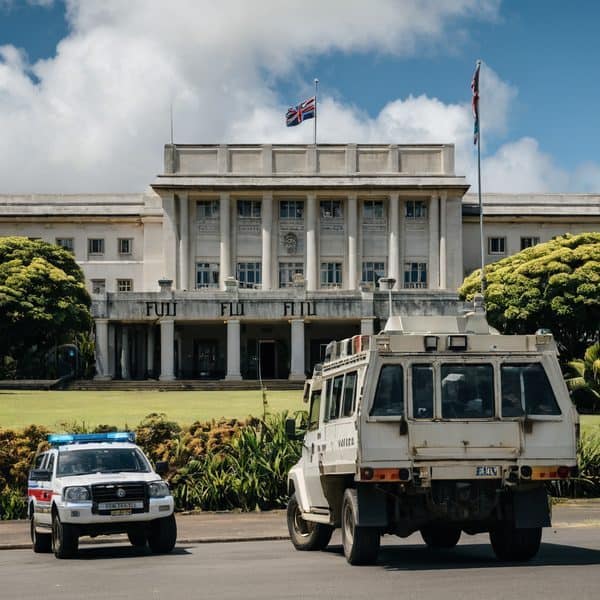
The Home Affairs Minister has outlined a new hybrid security model that would place the Republic of Fiji Military Forces and the Fiji Police Force under clearly defined legal frameworks to enable joint operations while preserving distinct roles and responsibilities. Speaking in Parliament, Minister Pio Tikoduadua said the model is intended to deliver faster, more coordinated responses to emerging threats by removing legal uncertainty that can delay action.
Tikoduadua told lawmakers the concept draws on elements of Australia’s NORFORCE approach, where military and law-enforcement bodies cooperate under established rules to protect critical areas. In Fiji’s adaptation, he said, the police would retain command of operations and request military support when needed; the military’s role would be bounded by strict operational and legal limits so assistance is targeted and accountable.
The proposal is being advanced alongside a government review of the Republic of Fiji Military Forces Act and development of a new Defence Management framework. Tikoduadua framed the package as part of a broader effort to modernise national security architecture and to safeguard critical infrastructure, explaining that clarifying legal responsibilities is central to enabling prompt, lawful action during security incidents.
The minister said the initiative responds in part to recent events that tested existing systems — including attempted security breaches that, while treated as serious offences, exposed gaps in coordination. He noted that electronic safeguards had helped but that those incidents demonstrated the value of having pre-defined mechanisms for rapid military support to civilian law enforcement when circumstances require it.
Tikoduadua also acknowledged public calls for increased military involvement in security matters, but emphasised the hybrid approach as a measured response that recognises Fiji’s political history and the need to protect democratic governance. “The goal is a professional, well-coordinated security structure capable of responding immediately and effectively to national threats,” he said, reiterating that police leadership and legal oversight would remain core principles.
The proposal complements ongoing capacity-building in the security sector. Recent cross-agency maritime training and international assistance — including a US funding package aimed at boosting naval communications — reflect government efforts to strengthen interoperability among the navy, police and other agencies. Supporters argue that clearer legal arrangements for military assistance will build on those practical gains by ensuring roles, responsibilities and limits are codified.
Next steps are expected to include drafting legislation and the Defence Management framework to translate the hybrid model into operational practice. The minister’s remarks in Parliament signal a shift from ad hoc deployments toward a formalised, legally grounded mechanism for military–police collaboration; the shape and safeguards of that mechanism will be a focus of debate as the review of the RFMF Act proceeds.