
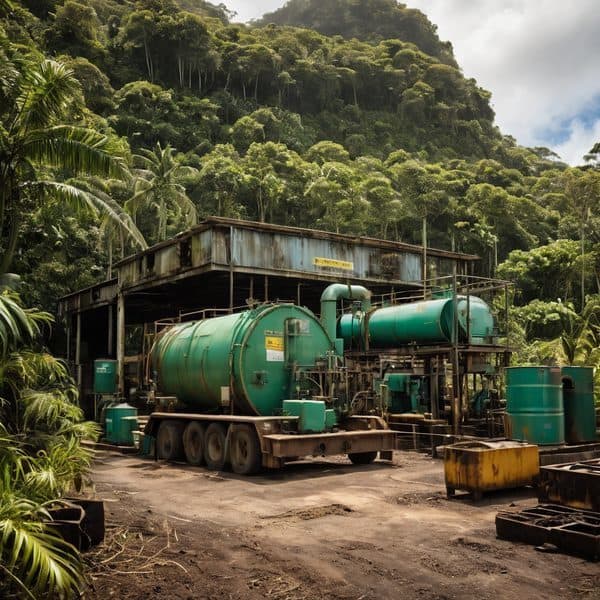
Vanuatu has opened a pilot facility to turn waste oil from ships into usable fuel, a move authorities and industry backers say could both clean up hazardous waste and bolster the country’s energy security. The small-scale plant, located at Melek Tree on Efate, is being operated by Oceans Environmental Solutions, a company led by Australian entrepreneur Andrew Bohn.
The core technology at the site is a pyrolysis unit. Under vacuum and heat, contaminated oil is vaporised, with the hydrocarbon vapours then cooled and condensed to produce a reusable fuel fraction. “The problem is there’s no way to recycle oil in Vanuatu. Australia has similar systems to recycle oil as the US,” Bohn said, noting that without such capacity the only local options have been long-term storage or illegal dumping. He warned that continued storage increases stockpiles while uncontrolled disposal risks soil and water contamination.
Vanuatu has long lacked a formal recycling pathway for waste oil generated by shipping and local industries, leaving islands to cope with accumulating drums of used oil or unsafe disposal that threatens community and environmental health. The Melek Tree pilot is presented as the first practical alternative on Efate, intended to demonstrate whether pyrolysis can be operated safely and at a scale that meaningfully reduces hazardous stockpiles and dependence on imported fuel.
The national Department of Environment is supervising the project and has begun public consultations around the site. Officials have pledged strict ongoing monitoring for emissions, odour and any other environmental impacts, and have said the pilot could be relocated or shut down should monitoring reveal unacceptable risks. Those safeguards are intended to reassure nearby communities wary of industrial operations and to ensure the process meets Vanuatu’s environmental standards.
Project backers argue the initiative tackles two problems at once: converting hazardous waste into a usable energy source and improving national fuel resilience. If the pilot proves environmentally safe and economically viable, proponents say it could be scaled up on Efate or adopted in other Pacific island nations that face similar hazardous-waste and energy challenges. Bohn and his team point to comparable recycling systems in Australia and the United States as operational precedents.
The pilot’s immediate milestones are focused on community engagement and environmental oversight rather than rapid expansion. Public consultations and the Department of Environment’s monitoring will shape whether the plant stays at Melek Tree, is moved, or is closed. Those outcomes will determine whether the project becomes a model for broader regional uptake or remains a limited experiment in converting maritime waste into fuel. Source: VBTC News.