
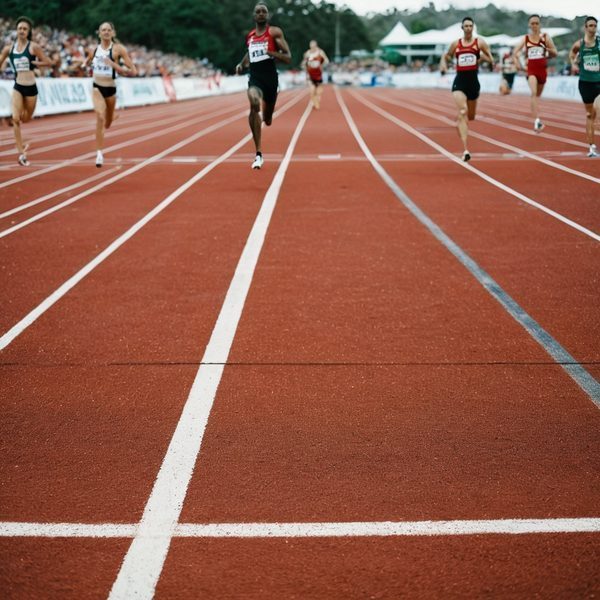
After 65 years of the Coca‑Cola Games, a controversy over athletes diving across the finish line has intensified after back‑to‑back high‑profile school races brought the tactic into sharp focus. The debate rekindled on the final day of this year’s meet when Suva Grammar School’s Paula Vonolagi dived to the tape to snatch the senior boys 200 metres, narrowly edging Queen Victoria School’s Jone Raibevu and claiming a second gold for Suva Grammar. The move has prompted renewed calls for clarity from officials and raised fresh questions about fairness and sportsmanship in Fiji’s premier schools athletics meet.
Vonolagi, who trailed Raibevu in the closing 50 metres, said after the race that he “knew the race would be tough” and was “determined to prove himself,” a determination that culminated in a centimetre‑deciding dive across the line. The tactic immediately divided spectators and coaches: some hailed the dramatic finish as evidence of total commitment, while others described it as bordering on a “cheat,” arguing it rewards risk over running ability. The winning margin was so small that photos and the judges’ interpretation of the torso rule were decisive.
The recent controversy echoes an earlier Coca‑Cola Games moment when Elijah Tokikivunuku of Suva Grammar dived to win the senior boys 400m final in 2022. That race also sparked debate but did not lead to an overhaul of rules. What is new now is the accumulation of high‑stakes finishes using the same manoeuvre within a short span, prompting parents, rival schools and some coaches to question whether Athletics Fiji should more actively address the practice to preserve what they see as the integrity of track competition.
Under World Athletics rules, an athlete’s finishing position is determined by the part of the body (specifically the torso) that first breaks the vertical plane of the finish line, rather than by the head, arms or legs. That interpretation effectively legalises lunges, dips or dives if the torso crosses first — a point supporters of the tactic cite. The rules are not explicit about diving as a technique, but they do not prohibit it, leaving the manoeuvre permitted if executed within the torso definition. Opponents say the rules’ silence creates a loophole that allows athletes willing to risk injury to gain an advantage.
Diving finishes are not unique to Fiji. Internationally, Olympic champions have employed similar tactics: Bahamian Shaunae Miller‑Uibo famously dove to win the 400m title in Rio 2016, while American David Neville’s 2008 bronze and Brazilian João Vítor de Oliveira’s 2016 hurdle qualification are other cited examples. Yet local critics argue that while elite professionals may train for the risk and have medical back‑up, many school athletes are neither coached to dive safely nor prepared for the possible injuries — a factor that, they say, creates an uneven playing field.
Calls are growing for Athletics Fiji to clarify its stance and consider guidance or education on finish‑line technique for schools. Some suggest running clinics on safe finishing mechanics or issuing a formal policy on dives and lunges to avoid ad‑hoc decisions in tight photo finishes. Athletics Fiji has not publicly changed the rules, and any formal amendment would need to align with World Athletics’ definitions.
As the debate continues, the Coca‑Cola Games’ tradition of fiercely contested finishes has acquired a new dimension: whether victory should be decided solely by running skill and speed, or whether last‑second dives are an acceptable, if controversial, part of competitive strategy. The outcome of the current discussion could shape coaching and competition practices across Fiji’s schools athletics for years to come.