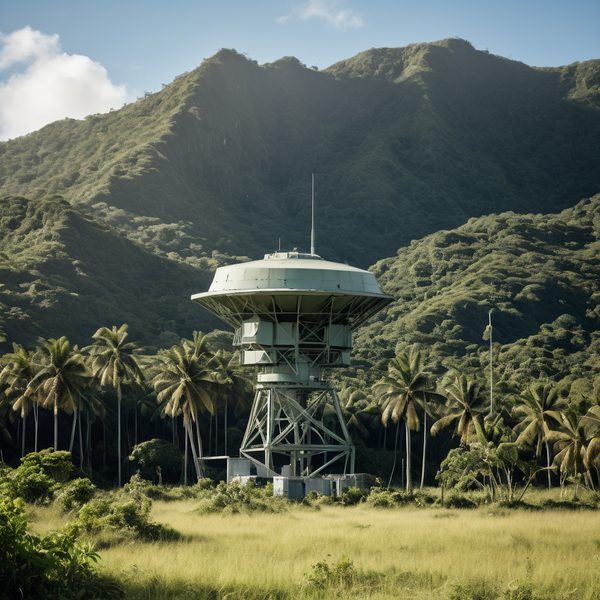
A new security report released as Palau’s leader makes a historic state visit to New Zealand warns that the rapid expansion of U.S. military infrastructure in Palau has outpaced environmental safeguards and public consultation, leaving island communities sidelined and legal obligations under the Compact of Free Association undermined.
The Micronesia Security Outlook 2025, published by the Guam-based Pacific Centre for Island Security, singles out Palau as a case where “guardrails” intended to protect the country’s environment and sovereignty have proved ineffective against accelerated militarisation. The Palau chapter was written by Jodean Remengesau, director of the Bureau of Agriculture at Palau’s Ministry of Agriculture, Fisheries and the Environment, who says the U.S. military has “missed and fell short of fulfilling its duties and responsibilities under the compact” with Palau.
The report recounts a high-profile land clearance on Angaur, one of Palau’s 16 states, where US forces prepared a site for a tactical mobile over-the-horizon radar system. According to Remengesau, the clearing proceeded without an environmental earthmoving permit and without the community consultations required by Palauan law. The report describes shredded tree debris left at the site that “invited invasive coconut rhinoceros beetle infestation” and was later dumped on residents’ yards in a rushed attempt to deal with the problem — a sequence Remengesau says the compact’s environmental stipulations were designed to prevent.
The Angaur episode has already produced legal consequences. In 2023, Angaur Governor Steven Salii sued Palau’s central government, the Palau Environmental Quality Protection Board, the U.S. government and its military contractors, alleging violations of Palau’s environmental laws and compact agreements after 271,807 square metres of land were cleared without an environmental impact assessment or permits. The filing remains a focal point for concerns about accountability and local rights amid intensified military activity.
Those activities have been driven in part by Palau’s changing geopolitical role. Under a renegotiated compact, the United States pledged an US$890 million assistance package to Palau over 20 years, a cycle that began on October 1, 2023. The compact continues to grant the U.S. military exclusive access to Palauan land, waters and airspace while also obligating the U.S. to meet environmental standards — a tension the report highlights, noting that a significant share of Palau’s national budget comes from compact funds and foreign aid.
The report also flags a major radar project valued at US$118 million that the U.S. military expects to be operational this year. It raises another transparency issue: a shoreline radar tower system initially presented to Palauan authorities and the public as “a single infrastructure for mutual use” later emerged as two separate installations — a discrepancy that has fuelled mistrust over how infrastructure is being described and deployed.
Palauan President Whipps’ state visit to New Zealand on April 13, 2026 — described by Wellington as the first-ever Palauan state visit to the country — comes as these findings gain traction internationally. The visit provides Palau with a higher diplomatic platform even as domestic and technical disputes over military installations, environmental oversight and community consultation continue to surface.
The Micronesia Security Outlook 2025 calls for clearer enforcement of compact environmental conditions, improved transparency in infrastructure planning, and stronger mechanisms for community consultation. For Palau, the report reinforces longstanding anxieties that strategic value on the geopolitical chessboard may be eroding protections for local environments and customary rights unless concrete accountability measures are enforced.
Leave a comment