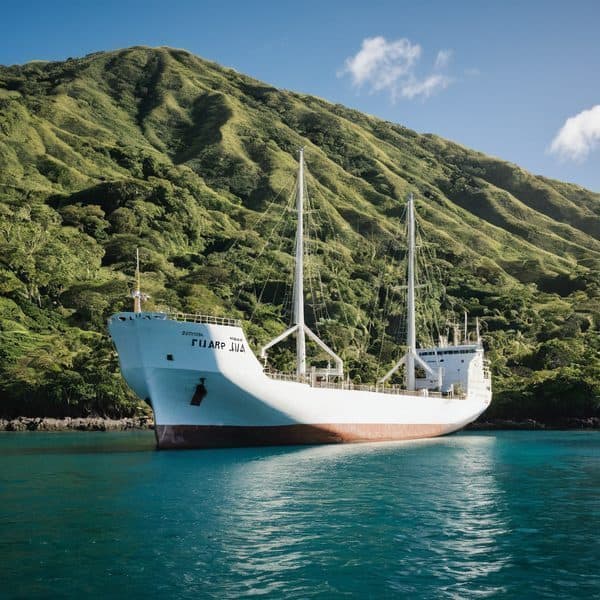
Pacific island shipping — a literal lifeline for remote communities — is facing a mounting crisis, with regional experts urging an urgent shift toward wind-assisted propulsion and other low-carbon technologies to cut fuel costs and shore up connectivity. Speaking at a regional discussion on low-carbon maritime transport, Natasha Chan, assistant legal researcher at the Micronesian Centre for Sustainable Transport, warned that ageing fleets, heavy reliance on imported fossil fuel and weak maintenance regimes leave island services fragile and communities exposed to supply shocks.
Chan said the Pacific suffers some of the world’s highest maritime connectivity costs and long, sparse routes that make conventional decarbonisation solutions difficult to apply. Research cited at the meeting shows fuel savings of at least 40 percent are achievable with existing technologies if adapted for Pacific conditions; earlier wind-assisted trials in the 1980s recorded savings of about 30 percent, and modern designs could improve on that. But Chan warned the region needs dedicated research, finance and development modalities at its scale rather than simply downsizing technologies proven in larger markets.
The call for tailored investment arrives as the Pacific’s maritime governance landscape changes. Since the International Maritime Organization opened a regional presence office in Suva last year and Fiji has tightened measures to tackle derelict vessels and require shipwreck insurance, regional officials say there is growing institutional capacity to support cleaner, safer domestic shipping. That matters as global shipping reforms, including emissions-related penalties beginning to take shape internationally, threaten to push up costs for operators who do not adapt.
The PACNEWS bulletin carrying the transport discussion also flagged a string of fresh regional developments. Timor-Leste President José Ramos-Horta warned his country is vulnerable to “infiltration by foreign organised crime,” a security concern that could have broader implications for governance and cross-border enforcement. In the Solomon Islands, Gizo hospital declared a state of emergency, while Fiji’s Climate Change Minister outlined key priorities intended to accelerate climate action across the Pacific — details of which are expected to feed into upcoming regional planning.
Domestic and regional social services and law enforcement also featured. The Fiji Chief Justice described retirement rules as “discriminatory,” and the World Council of Churches’ general secretary will attend the Pacific Church Leaders’ Meeting in Fiji. The University of the South Pacific announced it is doubling student support amid a global crisis, and Papua New Guinea’s Health Minister, Dr. Kapavore, praised a visiting Chinese medical ship for bolstering local health services.
The business and law enforcement brief included a string of notable items: a Luganville businesswoman was jailed in a VT143 million cigarette smuggling case; Vanuatu Prime Minister Napat launched Emua Vila, the country’s first economic micro-hub; and a prominent commentator, Anthony, warned that any fuel price rise will have a drastic impact on Fiji workers. The bulletin also highlighted a probe into a politically connected crypto project that pursued a resort linked to figures alleged to be part of a scam syndicate, and reported that Weather Ready Pacific is strengthening early warning systems to better protect island communities from climate hazards.
Taken together, the updates underline a region juggling immediate humanitarian and governance pressures while trying to position maritime transport, climate policy and disaster resilience for a changing global and environmental landscape. The shipping sector’s shift toward practical, Pacific-scaled low-carbon solutions was presented as pivotal — both to reduce emissions and to protect the everyday flow of goods and services that island life depends on.
Leave a comment