

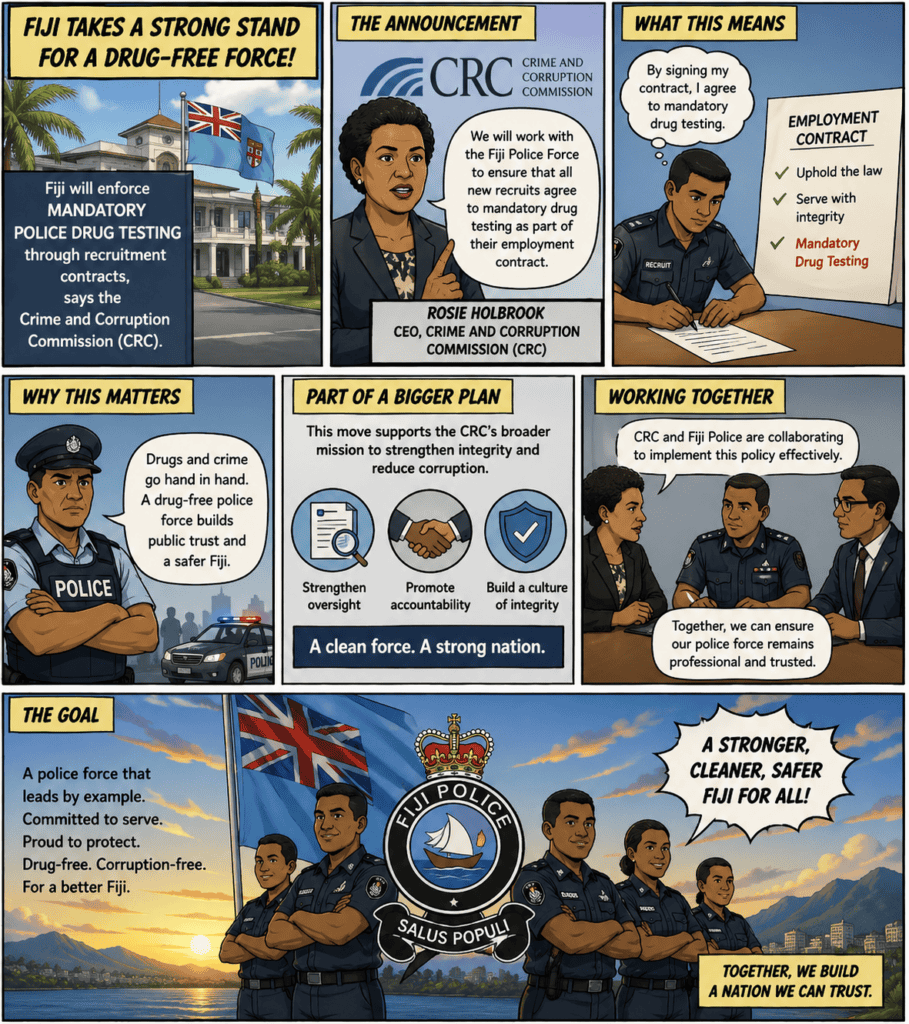
Dr John Fatiaki, a commissioner on Fiji’s Constitution Review Commission (CRC), has told stakeholders that mandatory workplace drug testing can lawfully be imposed as a condition of employment without needing changes to the Constitution. His comments, delivered while responding to police concerns about consent and constitutional protections, represent a shift in the debate from arguing for constitutional amendment to pursuing internal employment policy solutions.
Police had earlier raised objections that mandatory drug testing would infringe Section 11(3) of the 2013 Constitution, which guarantees “the right to freedom from scientific or medical treatment or procedures without an order of the court or without his or her informed consent.” Dr Fatiaki said those concerns can be addressed by incorporating drug-testing requirements into the terms and conditions of recruitment, so that prospective employees give informed consent before joining an organisation such as the police force. “It is a policy direction that you can use to ensure that we are in line with what is required,” he said, adding that he understood the commissioner “doesn’t have power to direct.”
Drawing on international and domestic examples, Dr Fatiaki referenced industries where mandatory testing is already routine — notably cruise operations and Fiji Airways — arguing that precedent exists for conditioning employment on testing. “When people apply, they must consent to a mandatory drug test. If you refuse to undergo the test, you get off the boat,” he said, urging a similar contractual approach for policing roles. He said refusal to comply with those pre-agreed conditions could be treated as grounds for disciplinary action or termination. “Part of the contract, it could require that in the nature of the profession, mandatory drug testing may be required, and we require that all candidates for employment as police officers sign it.”
Dr Fatiaki also warned against expanding or altering constitutional provisions to resolve what he described as operational questions. He argued the Constitution should remain broad and principle-based, with detailed operational rules set by policy and legislation rather than constitutional text. That stance aligns the CRC’s remit — reviewing fundamental rights and structures — with leaving day-to-day employment and disciplinary frameworks to government agencies and employers.
The latest intervention comes amid broader national efforts to strengthen anti-narcotics capability. The government recently opened recruitment for the new Counter Narcotics Bureau, part of a wider strategy to tackle trafficking and related organised crime. Fatiaki’s framing indicates that future hiring and workplace rules across the security services could include explicit drug-testing clauses, avoiding protracted legal disputes over constitutional interpretation.
If adopted, the contractual-consent model would allow police and other safety-sensitive employers to require testing at recruitment, randomly, or after incidents, while relying on employment law and disciplinary processes to enforce compliance. Legal experts and unions may still press for safeguards on testing procedures, privacy, and appeals — issues that were not fully addressed in Dr Fatiaki’s remarks but are likely to surface as agencies move from principle to policy.