
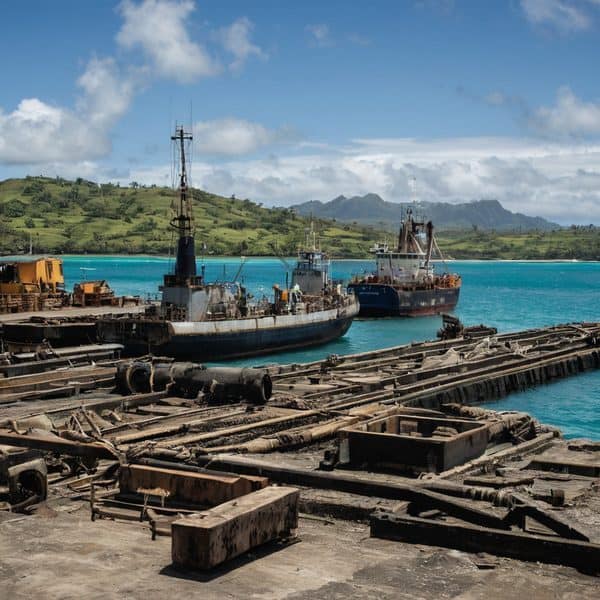
The Standing Committee on Natural Resources has tabled a sweeping set of recommendations aimed at overhauling Fiji’s port network, urging urgent capital investment, safety repairs and governance reforms to boost capacity, efficiency and climate resilience. The committee’s consolidated review of Fiji Ports Corporation Limited’s (FPCL) 2020–2023 annual reports, presented to Parliament, identifies priority projects and operational weaknesses that it says must be addressed to protect trade flows and support national economic growth.
At the centre of the committee’s proposals is a major upgrade to Malau Port in Labasa. The report recommends immediate repair of a damaged dolphin structure at Malau, flagged as a safety risk, and calls for consideration of Malau as a designated port of entry under the Government’s Look North Policy. The committee said accelerating works at Malau is critical to meet growing demand in northern Vanua Levu and to reduce safety and service-delivery bottlenecks for cargo and passenger movements.
The committee also recommended the phased decommissioning of Levuka Port, but made that contingent on thorough feasibility studies and wide stakeholder consultation. Any transition away from Levuka, the panel said, should be carefully planned to avoid disruptions to communities and commercial services that currently depend on the port.
In the north-east, the committee identified Savusavu as needing a modernised facility, proposing development of a new port at Balaga Bay capable of handling increasing cruise ship visits and expanding cargo volumes. The report links such investments to broader opportunities from tourism growth and regional trade, but notes they will require dedicated funding, including tapping climate resilience finance for infrastructure that can withstand stronger cyclones and sea-level impacts.
Operational and financial reforms form a substantial portion of the recommendations. The committee urged FPCL to accelerate measures to improve cargo-handling efficiency and reduce vessel turnaround times, while tightening revenue management and cost controls to improve commercial performance. It also called for stronger governance and risk management arrangements, improved environmental oversight of port operations, the adoption of advanced digital monitoring systems, and enhanced transparency — including gender-disaggregated reporting where applicable.
The committee’s recommendations come as part of a push to modernise Fiji’s transport arteries and align port capacity with projected trade and tourism growth. While the review covers FPCL activity from 2020 to 2023, the panel stresses urgency: several items, notably the Malau dolphin repair and actions to cut vessel dwell time, were identified as immediate priorities. The committee has asked government agencies and FPCL to respond with implementation plans, feasibility studies and timelines for consultations and funding strategies.
The report does not yet set funding sources or firm timelines for the larger capital projects; next steps will depend on government decisions, FPCL planning and the outcome of the proposed feasibility studies. Ministers and FPCL executives are expected to provide formal responses to Parliament following the committee’s recommendations, which aim to position Fiji’s ports as more resilient, efficient gateways for commerce and tourism.