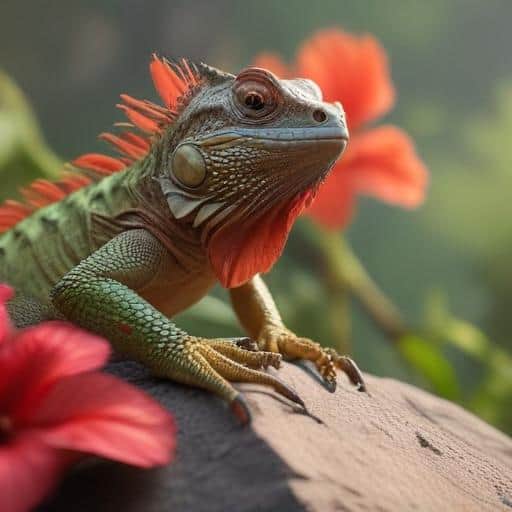
New genetic research shows Fiji’s iconic Vokai (Brachylophus) iguanas are the descendants of North American desert iguanas that crossed the Pacific more than 8,000 kilometres (roughly 5,000 miles) in a single, extraordinary rafting event millions of years ago.
A team led by Dr Simon Scarpetta (University of San Francisco) used advanced genome sequencing—analysing more than 4,000 genetic markers from iguanid lizards across the Americas and the Pacific—to trace the origins of Fiji’s iguanas. Their results place the split between Brachylophus and their closest living relatives, the North American desert iguanas (Dipsosaurus), at about 34 million years ago. That timing lines up with the emergence of Fiji’s volcanic islands, making long-distance rafting the most plausible route of colonisation and ruling out ancient land bridges or chain-of-islands explanations.
The likely scenario involves a single, unprecedented trans-Pacific voyage on floating mats of vegetation. Modern observations show iguanas can survive on such debris, and the species’ physiological traits—tolerance of heat and dehydration, the ability to endure long periods without food, and herbivorous diets—would have helped individuals survive months at sea while riding prevailing currents from the western coast of North America to Fiji.
If confirmed, this is the longest recorded rafting dispersal for a terrestrial vertebrate, exceeding previous examples such as skinks and geckos that crossed the Indian Ocean to Madagascar (about 4,000 km). The finding expands our understanding of how traits and chance combine to allow species to colonise remote islands and highlights how island isolation can drive rapid diversification once pioneers arrive.
The study has urgent conservation implications. Fiji’s iguanas are now critically endangered, threatened by habitat loss, invasive predators and other human pressures. Authors of the research stress that these lizards are living relics of a remarkable evolutionary journey—losing them would erase a unique chapter of natural history. The paper also prompts broader questions: if iguanas achieved such a crossing, might other, less-studied groups have made similar voyages? Future work could search for hidden dispersal histories in insects, small mammals, and other island fauna.
Summary
– Genomic analysis identifies North American desert iguanas as the closest relatives of Fiji’s Brachylophus.
– Divergence dated at ~34 million years ago, coinciding with Fiji’s island formation.
– Most likely arrival: a single, lengthy rafting event across ~8,000 km of ocean.
– This represents the longest known transoceanic rafting dispersal for a terrestrial vertebrate.
– Conservation urgency: Fiji’s iguanas are critically endangered and require protection.
Additional comments and practical implications
– Conservation priorities should include habitat protection, invasive species control (rats, feral cats), strengthened biosecurity to prevent further introductions, and supported captive-breeding or insurance populations where feasible.
– Community-led conservation and integration of indigenous knowledge can strengthen local stewardship and monitoring.
– Further genetic and fossil research across Pacific and American lineages could reveal more examples of long-distance dispersal and refine timelines.
– The discovery underscores resilience and adaptability in nature—knowledge that can inspire public support for protecting island biodiversity.
Hopeful note
This discovery is a reminder that life can endure and innovate across staggering distances. Recognising the Vokai as the survivors of an epic voyage adds urgency—and public fascination—to efforts to secure their future, offering a powerful narrative to rally conservation action.
Leave a comment