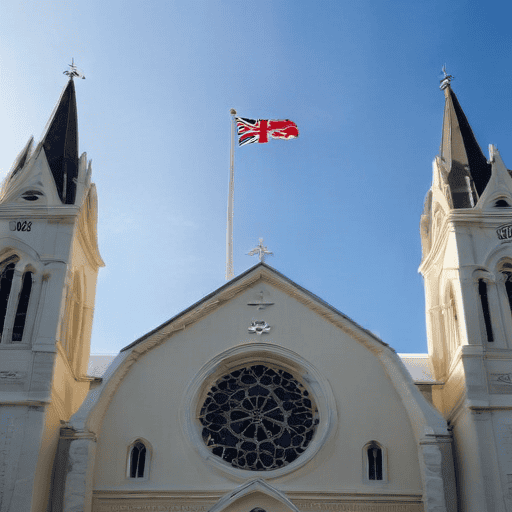
Located in the vibrant heart of Suva City, the Cathedral of the Sacred Heart serves as the focal point for the Catholic Church in Fiji, catering to over 80,000 parishioners within the Archdiocese of Suva. This majestic structure holds immense historical and spiritual value for the community.
John Pickering, the Director of Communications for the Archdiocese, shared in a 2020 interview that the term “cathedral” is derived from the Latin word “cathedra,” meaning “seat.” He noted that the Sacred Heart Cathedral houses the cathedra of the archbishop, symbolizing his teaching authority.
The genesis of the cathedral can be traced back to 1888 when Fiji’s first bishop, Julien Vidal, acquired the land for its construction. Initial efforts, led by Father Rosier, faced delays due to inadequate materials and limited funding. A significant turning point occurred when Bishop Vidal, during a visit to Australia, sourced suitable stone blocks in Sydney, which were subsequently imported for the project.
The foundation stone was laid in 1894, with support from two New Zealand bishops, and Bishop Vidal enlisted Father Rosier to return and oversee the work. Although the crypt was completed by 1896, financial limitations hindered further progress. In pursuit of funds, Bishop Vidal traveled to Europe, where he met architect Pierre Bourdier. Encouraged by Bourdier to join the Marist Order, the architect accompanied the bishop back to Fiji in 1897 to continue the construction.
The main structure was finished in 1902, but delays persisted with the construction of the towers and choir area due to financial challenges. The cathedral was officially blessed and opened on July 20, 1902. Architect Bourdier continued to contribute to the cathedral’s design until his passing in 1937, after which the towers and choir remained incomplete.
It wasn’t until 1994, marking the 150th anniversary of the Marist missionaries’ arrival in Fiji, that significant expansions, including the sanctuary and sacristy, were successfully completed under the guidance of the late Archbishop Petero Mataca. These new additions were blessed by Papal Envoy Josef Cardinal Tomko on August 15, 1994.
Designed in the Gothic architectural style reminiscent of European cathedrals, the Sacred Heart Cathedral has taken over a century to reach its current form. It continues to be a cornerstone for Catholic worship and community service, conducting various programs such as faith formation, youth initiatives, charitable outreach through the St. Vincent de Paul Society, and support programs for widows and single mothers.
The cathedral can accommodate around 1,000 worshippers and has been led by six Catholic Church heads since its inception. Although the Archbishop serves as the parish priest, day-to-day operations are managed by Father Cecil Williams, with assistance from Father Ioani Vodosiro. Since the 1994 refurbishments, no major structural changes have been made, allowing the cathedral to retain its historical and architectural integrity.
In a reflection of its enduring legacy, the Sacred Heart Cathedral remains a vital space for faith and community, a testament to resilience and commitment to service over the years.
This narrative highlights the rich cultural heritage and the communal spirit that the Sacred Heart Cathedral embodies, offering hope and fostering unity among its parishioners.
Leave a comment