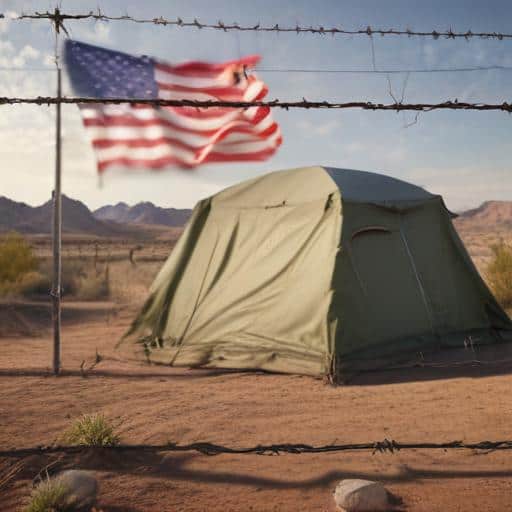
The U.S. military has established a second military zone along the border with Mexico, adding a “Texas National Defense Area” to a previously designated military zone in New Mexico. This new area, which spans 63 miles from the Texas-New Mexico border in El Paso, allows troops to temporarily detain migrants and trespassers. The zones are part of President Donald Trump’s intensified immigration enforcement campaign aimed at detaining migrants without invoking the 1807 Insurrection Act, which permits military intervention during civil disorder.
Currently, approximately 11,900 troops are stationed at the southern border. The launch of the Texas zone comes after 82 migrants were charged for illegal crossings into the New Mexico area, where U.S. Customs and Border Protection (CBP) officials have been handling migrant cases. Notably, Texas Governor Greg Abbott has actively supported measures to curb illegal immigration, including the construction of razor-wire barriers.
In contrast, New Mexico Governor Michelle Lujan Grisham has opposed what she describes as a “deportation buffer zone,” labeling it a misuse of resources. Concerns have also been raised by New Mexico U.S. Senator Martin Heinrich regarding the potential impact on civilians, noting that the military zone could encroach significantly beyond what was previously believed, raising safety and accessibility issues for residents.
This expansion of military authority and troop presence along the border reflects ongoing tensions surrounding immigration policy in the U.S., emphasizing the need for a balanced approach to managing border security while considering humanitarian implications. Developments in these military zones underscore the complex dynamics of U.S. immigration strategy, eliciting mixed responses from local and state leaders.
As discussions continue on immigration enforcement and its effectiveness, there is a glimmer of hope that constructive dialogues may lead to improvement in policies that support both national security and compassion for those seeking refuge. The potential for collaborative efforts at the state and federal levels could foster a more humane immigration system moving forward.
Leave a comment