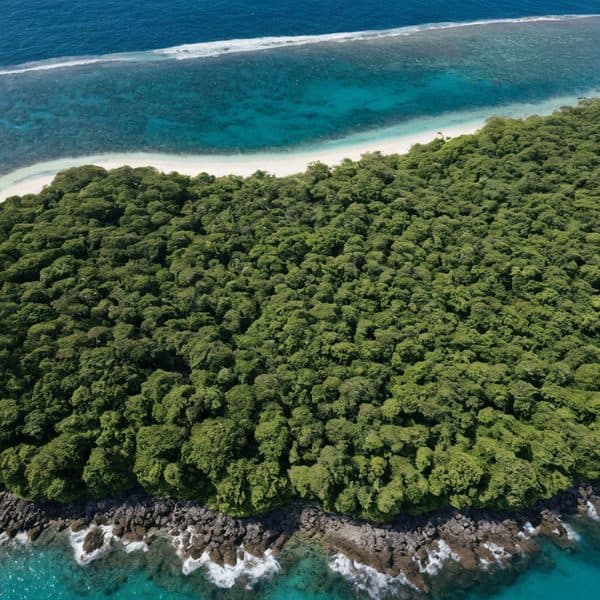
A shell-dense island off Culasawani on the north coast of Vanua Levu has been identified as what researchers say may be the first recorded “midden island” in Fiji and the first such site documented in the South Pacific west of Papua New Guinea. The finding, led by University of the South Pacific geographer Patrick D. Nunn and published in the journal Geoarchaeology, offers fresh evidence of how early Fijian communities exploited coastal resources and adapted to changing shorelines.
The feature, roughly 3,000 square metres in area and rising up to 60 centimetres above high-tide level, is dominated by shell material, making up an estimated 70 to 90 percent of its composition. Excavations comprised test pits and stratigraphic analysis, and radiocarbon dates cluster around 1,190 years before present. The dating places human activity at the site broadly between about 420 and 1,040 AD, a period that overlaps with major phases of Pacific island colonisation and local environmental shifts.
Archaeologists recovered abundant shellfish remains—principally from edible species—and pottery fragments alongside the shell deposits. By contrast, no stone tools or faunal bones were identified in the test pits. Those material patterns underpin the study authors’ interpretation that the island accumulated through repeated human processing and discard of shellfish rather than by a single catastrophic event. The team considered and tested an alternative hypothesis that the deposit resulted from a tsunami or large wave, but found only limited support for wave deposition; the exclusive presence of edible shell species argues for sustained human collection and consumption.
The researchers propose that the midden island likely formed as local people processed large quantities of shellfish over time, possibly while living on stilted structures built above shallow coastal waters. Such an arrangement would have allowed communities to exploit intertidal resources intensively while avoiding low-lying ground vulnerable to tides and storm surge. The discovery therefore casts new light on subsistence strategies in early Fiji, highlighting shellfish as a central dietary component and demonstrating a practical community adaptation to shifting sea levels and shoreline dynamics.
If confirmed as a midden island, the Culasawani site extends the regional record of shell-dominated deposits and suggests more complex coastal settlement patterns in western parts of the South Pacific than previously documented. The authors note the importance of locating associated habitation sites inland or nearby to establish how food-processing deposits relate to broader settlement layouts and social organisation.
The team plans further fieldwork aimed at identifying nearby settlement remains and clarifying the relationship of the midden island to wider human activity across Vanua Levu. The new study underscores the value of coastal geoarchaeological research for reconstructing early Pacific lifeways and for understanding how past communities coped with environmental change.
Leave a comment