
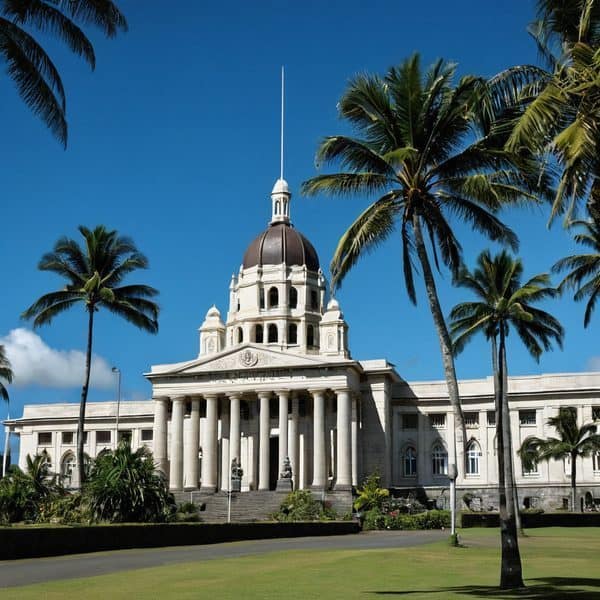
Opposition members of Parliament pressed the government on Fiji’s deepening diplomatic engagement with Israel on Wednesday, questioning a newly tabled Memorandum of Understanding (MOU) on cooperation in diplomatic training as the Foreign Affairs Minister defended the pact as a capacity‑building exercise that would not compromise Fiji’s independent foreign policy.
Minister for Foreign Affairs and External Trade Sakiasi Ditoka told Parliament the MOU is aimed at strengthening cooperation “across a wide range of priority sectors, with a focus on capacity building as a key driver of national development.” He described the agreement as consistent with Fiji’s long history in international peacekeeping and said the training offer was intended to broaden the skillset of Fijian diplomats rather than signal political alignment.
Ditoka noted recent steps to deepen bilateral ties, including Fiji’s establishment of an embassy in Jerusalem in September 2025 and Israel’s planned opening of an embassy in Suva in June. The minister reiterated that such exchanges were driven by practical considerations for national development and diplomatic experience: “We work with countries across different regions and different political systems because our duty is to advance Fiji’s interests and create opportunities for our people,” he said. He added that exposure to complex environments can be instructive and “will add to Fiji’s diplomatic experience.”
Opposition MP Jone Usamate pressed the government on whether the wider geopolitical context had been factored into the agreement, pointing to ongoing conflicts in Gaza and southern Lebanon. Usamate asked how those developments might influence the substance or direction of training provided under the MOU and whether closer engagement could be perceived as taking sides in conflicts that remain deeply sensitive across the Pacific and internationally.
In response, Ditoka insisted the MOU was technical and educational in nature. “This is a capacity‑building initiative, not a political alignment, and will not affect Fiji’s independent position in international forums,” he told MPs, adding that Fiji would continue to engage with a wide range of international partners. His remarks echo previous government statements defending the decision to base Fiji’s embassy in Jerusalem, where the Prime Minister framed the move as an act of engagement intended to build bridges while reaffirming support for a two‑state solution as the path to lasting peace.
The parliamentary questioning marks the latest development in an evolving diplomatic shift that has drawn concern from sections of civil society and the international community since Fiji announced plans last year to locate its mission in Jerusalem. Critics have argued such moves risk entangling smaller states in polarising geopolitical disputes, while the government has maintained its right to pursue bilateral relations that serve national interests.
With the MOU now before Parliament and Israel’s mission expected to open in Suva in June, the debate is likely to continue. Lawmakers will watch for any implementing details of the training agreement — including curricula, participant selection and the scope of cooperation — that could clarify whether the partnership remains strictly technical or has broader political implications.