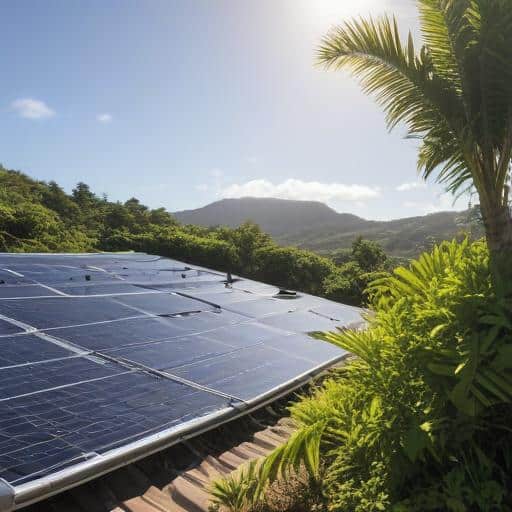
Buakonikai Primary School on Rabi Island has made history as the first school in Fiji to engage in a two-year off-grid renewable energy partnership, coinciding with an early celebration of International Women’s Day. The initiative, financed by the Australian government through the Pacific Climate Infrastructure Financing Partnership (PCIFP) within the Australian Infrastructure Financing Facility for the Pacific (AIFFP), aims to provide sustainable solar energy solutions to remote schools across Fiji.
Before this project, Buakonikai Primary School faced significant challenges due to the lack of electricity, which hindered teachers from printing materials, sending emails, and accessing online resources from the Ministry of Education. Students relied on outdated textbooks, severely restricting their educational experiences. However, the recent installation of a solar-powered energy system has transformed this reality. For the first time, the school’s four female teachers and 101 students now have access to electricity, allowing them to engage with modern educational tools and the internet.
Head teacher Katarina Tubekoro remarked on the transformative impact of this initiative on students’ digital learning experiences. “Previously, our students could only imagine what the world looked like, but now we can introduce them to real-life science experiments, documentaries, and interactive lessons,” she stated. Teacher Margaret Corrie, originally from Rabi, emphasized the newfound capabilities in science education, expressing excitement over the students’ reactions to digital technology. “When they first saw a digital television, they were in awe. Now they don’t want to leave school because they’re enthusiastic to learn,” Ms. Corrie observed.
The project is also notable for being spearheaded by women in the renewable energy sector, such as Vasiti Talakubu, a licensed electrician with over a decade of experience. Talakubu has dedicated her career to installing solar energy systems in remote areas, proving that women can excel in traditionally male-dominated fields. “I wanted to show that women belong in this field too,” she affirmed.
The AIFFP, contributing AUD100 million toward renewable energy projects across the Pacific, aims to ensure sustainable and long-term electricity access for schools, households, and businesses, thereby addressing critical educational needs in remote communities.
This initiative not only serves as a vital step towards enhancing educational infrastructure but also highlights the potential of renewable energy to empower women and improve conditions for future generations in Fiji.
Leave a comment