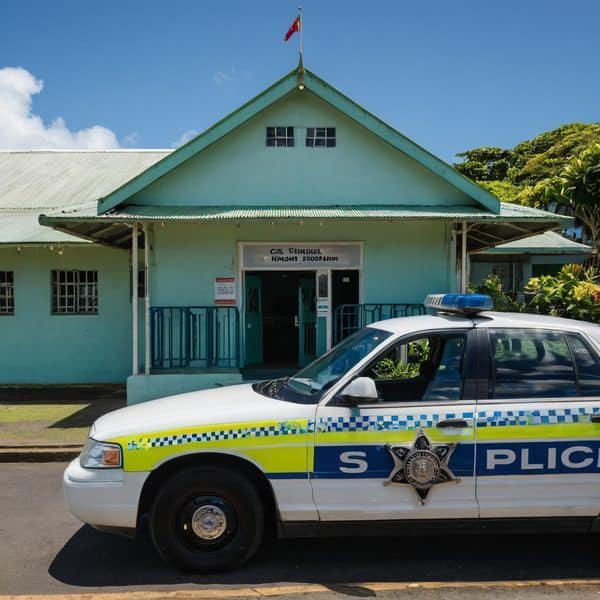
SUVA, 7 April 2026 — A new report released this week finds China is moving beyond technical police training in the Pacific to more operationally embedded roles with local law enforcement, a shift likely to reshape the contested security landscape across the region.
The study, summarised in a Pacific regional bulletin, says Beijing’s law enforcement engagement in the Pacific has expanded steadily over the past two decades and that Pacific Island countries are increasingly part of a broader overseas policing strategy. What began largely as support and training, the report says, “has developed into more operationally embedded relationships in several countries,” with Chinese police personnel now working closely alongside local counterparts on the ground.
The report describes an uneven footprint across the region. The Solomon Islands is identified as China’s most prominent policing partner, while smaller states such as the Cook Islands have also received sustained engagement. The Solomon Islands’ pivot toward deeper ties with Beijing after switching diplomatic recognition from Taipei in 2019 has been a focal point for analysts; Chinese policing cooperation there is now the most visible example of the broader trend, the report notes.
A notable and worrying feature highlighted by the study is that Chinese police liaison teams in some cases have begun to compete with established international partners. “Chinese police liaison teams have in some instances sought to discourage partners from other countries, signalling a willingness to compete at the operational level,” the report states. That competition comes as Australia and New Zealand — long-standing security partners in the South Pacific — continue large-scale efforts to bolster regional policing, including an Australian-funded A$400 million Pacific policing initiative announced in 2024 to expand training and create a mobile regional policing capability.
Despite concerns about Beijing’s growing presence, the report cautions against reading the shift as an immediate security takeover. Instead, it frames China’s engagement as a cumulative strategy that incrementally reshapes local policing arrangements and influence without provoking direct confrontation with traditional partners. “China’s role is best understood not as a security takeover but as a cumulative strategy that is reshaping the region’s policing landscape,” the report says, adding that Pacific governments themselves are diversifying partnerships rather than choosing sides.
For Fiji, which has been active in regional policing forums and operations — including sending police and security delegations to the Solomon Islands during the 2024 elections and participating at the UN policing summit last year — the evolution of external policing partners presents both challenges and opportunities. The report suggests Pacific states will need to balance the operational benefits of external assistance with concerns about sovereignty, standards and coordination when multiple international actors operate in the same space.
The study’s findings are likely to sharpen policy debates in Suva, Canberra and Wellington over how to coordinate aid, training, intelligence-sharing and law-and-order assistance in the Pacific. As China broadens its policing footprint, Canberra and Wellington — along with other partners such as the United States and multilateral agencies — face pressure to adapt their own engagement while Pacific governments assert agency in determining how external support is accepted and managed.
Leave a comment