
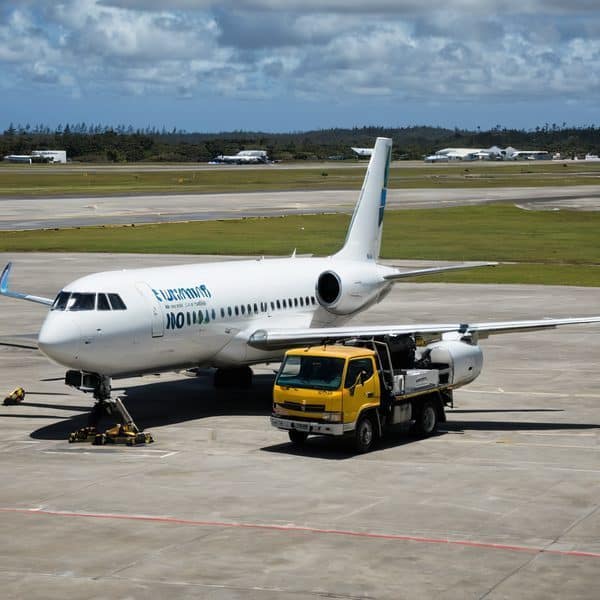
Air Terminal Services (Tonga) Limited has marked a new phase in its two-decade role as Tonga’s principal ground handling provider by securing the International Air Transport Association’s Safety Audit for Ground Operations (ISAGO) certification in 2024 and accelerating plans to electrify its operations to reduce reliance on imported diesel fuel. The privately owned company, which has operated under a concessionary agreement with the Tongan government for 22 years, says the certification and recent investments underline its position as the accepted handler for international carriers serving Tonga, including Air New Zealand, Fiji Airways and Qantas.
The ISAGO accreditation — achieved in 2024 — is significant for a small Pacific Island ground handler. In the region, only Fiji’s similarly named ATS has also attained the IATA audit, highlighting the rising technical and safety standards demanded by international carriers and regulators. ATS Tonga’s compliance supports the Tonga Civil Aviation Division’s acceptance of the company as the principal Ground Handling Service Provider (GHSP) at Fua’amotu International Airport, the only Tongan airport capable of accommodating large passenger jets.
Operations have had to scale with changing aircraft types and passenger patterns. ATS handles close to 100 widebody aircraft annually up to Boeing 777 and Airbus A330 size, and around 700 narrowbody jets per year. Smaller jets and turboprops such as the ATR72 service Vava’u and Fua’amotu, contributing to more than 500 international movements annually. Despite consistent traffic volumes — total passenger arrivals into Tonga have exceeded 100,000 per year across 2016–2026 — growth has been limited to about 5 percent over that decade, reflecting stagnant tourist numbers and the 2022 tsunami’s long-term impact on coastal resort capacity in Tongatapu.
Demographic shifts are reshaping demand. ATS notes a dramatic rise in diaspora movement: where outbound and return travel was nearly nil six decades ago, the Tongan diaspora now numbers about 250,000 compared with a homeland population projected to have grown from 75,000 in 1965 to roughly 105,000 in 2025. This has translated into distinct operational pressures: up to 10 percent of passenger loads can be elderly or mobility-impaired, requiring extra time and equipment for boarding and disembarkation and affecting on-time performance.
Financially, ATS reports revenue growth of about 50 percent from 2016 to 2026 — growth largely reinvested to match the capability of larger metropolitan GHSPs. Nevertheless, the company operates without air bridges or a pushback tug at Fua’amotu and has sourced stairways and hi-lift equipment to service widebody aircraft. Historically reliant on second-hand diesel ground service equipment (GSE), ATS says that model is no longer tenable given Tonga’s lack of local hydrocarbon or large-scale hydro resources and the rising cost and insecurity of diesel supplies.
To address that vulnerability and reduce emissions, ATS has begun transitioning to electric GSE and other renewable technologies. The company has purchased an electric stairway to serve all passenger jets and uses small electric ramp carts for passenger mobility assistance; it plans a broader shift to solar power to run GSE, office and hangar facilities and cold-chain systems for export and import cargoes. Those upgrades, executives say, are beyond current self-funding capacity — ATS has so far financed its own development and remains debt-free — and will require development funding, either grants or loans, to complete the transition.
Labour supply is another constraint. ATS employs 70 staff, of whom only about 35 percent have been with the company for 10 years or more. The exodus of working-age Tongans to seasonal labour schemes in Australia and New Zealand makes it harder to recruit and train new entrants for specialised ramp and technical roles, increasing the importance of retaining experienced supervisors and upskilling newer staff to meet international handling and safety standards.