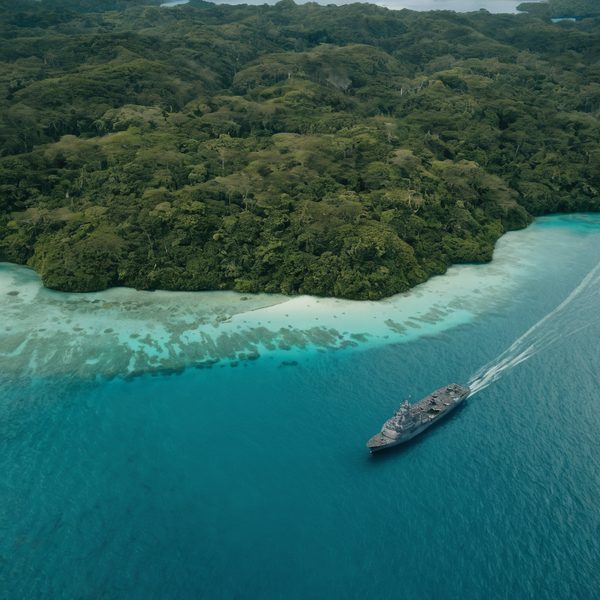
A new security analysis has amplified local unease over the expanding U.S. military presence in Palau, at the same time Palau’s head of state is on a historic first state visit to New Zealand, underscoring growing diplomatic activity as domestic concerns mount. The Guam-based Pacific Centre for Island Security’s Micronesia Security Outlook 2025, published this month, says safeguards meant to protect Palau’s environment and sovereignty are being undermined by accelerated militarisation that has left communities out of the consultation loop.
The Palau chapter of the report was authored by Jodean Remengesau, director of the Bureau of Agriculture in Palau’s Ministry of Agriculture, Fisheries and the Environment. Remengesau writes that while the Compact of Free Association grants the U.S. military exclusive use of Palauan land, waters and airspace and permits the installation of military infrastructure, those rights come with legally binding environmental obligations. “The U.S military had missed and fell short of fulfilling its duties and responsibilities under the compact of the U.S with Palau,” he writes, citing specific instances where Palauan law and compact stipulations were not followed.
One such episode detailed in the report involves land clearing on the state of Angaur for an initial site of a tactical mobile over-the-horizon radar system. Remengesau says the U.S. military cleared the site without obtaining an environmental earthmoving permit or conducting the community consultations required under Palauan statutes. The report describes shredded tree debris left at the site that created conditions conducive to an invasive coconut rhinoceros beetle infestation; in one instance, debris was later dumped on residents’ yards in hurried efforts to mitigate the problem.
The environmental dispute spilled into the courts in 2023 when Angaur Governor Steven Salii sued Palau’s central government, the Palau Environmental Quality Protection Board, the U.S. government and its military contractors. The lawsuit alleged violations of Palau environmental laws and compact agreements after 271,807 square metres of land in Angaur were disturbed without an environmental impact assessment or the necessary permits.
The report acknowledges the geopolitical drivers behind the increased activity — chiefly rising U.S.-China tensions — and warns that the island nation’s strategic location will likely draw Palau deeper into international security arrangements. Under the renegotiated Compact of Free Association, the United States committed an US$890 million assistance package to Palau over 20 years, which began on October 1, 2023. Remengesau and the report note that compact funds and foreign aid make up a large share of Palau’s national budget, increasing pressure to accommodate U.S. security infrastructure.
The U.S. military’s US$118 million radar project in Palau is pointed to in the report as a focal piece of the buildup. The project is now expected to be operational in 2026, a timeline that raises urgency around the unresolved environmental and governance questions, the report says. What was initially presented to Palauan officials and communities as a single shoreline radar tower system for mutual use, the analysis says, subsequently involved multiple installations — a development that Palauan commentators say changed the scale and local impact of the works.
The report and the legal challenge in Angaur add fresh complications to Palau’s foreign policy as President Whipps undertakes his unprecedented state visit to New Zealand. The diplomatic outreach signals Palau’s effort to broaden international engagement even as domestic debates continue over how to balance strategic partnerships, environmental protections and community rights.
Leave a comment