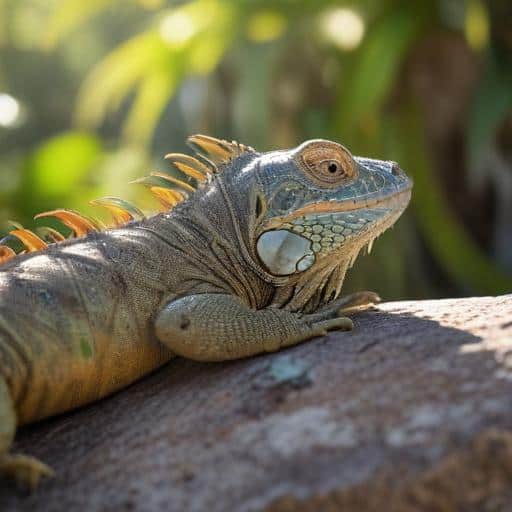
New research from the University of California, Berkeley, and the University of San Francisco has unveiled that iguanas made an astonishing 5,000-mile journey from the western coast of North America to Fiji. This transoceanic migration marks the longest recorded distance for terrestrial vertebrates, showcasing incredible adaptability and resilience.
Set to be published in the journal Proceedings of the National Academy of Sciences, the study indicates that the ancestors of the Fiji iguanas, classified as Brachylophus, likely reached the islands at some point between 34 million years ago and more recently. The analysis utilized genetic data which revealed that the closest living relatives of Brachylophus are the North American desert iguanas, or Dipsosaurus.
Lead author Simon Scarpetta, a herpetologist and paleontologist, highlighted the importance of this discovery, explaining that the link between Fiji iguanas and North American desert iguanas was previously unknown. Co-author Jimmy McGuire, a UC Berkeley professor, noted that initially, the idea of iguanas migrating directly from North America to Fiji seemed unlikely. However, their findings provide a viable explanation for the timing of their arrival, which aligns with the formation of land in what is now Fiji.
This research underscores the hardiness of iguanas, which are large herbivorous reptiles capable of enduring long stretches without food and water—traits that likely facilitated their extensive oceanic journey. As scientists delve deeper into the evolutionary trajectories and adaptations of species like the Fiji iguana, this breakthrough not only enriches our understanding of the past but also fosters optimism regarding conservation efforts in the face of climate change.
Moreover, the renewed focus on Fiji’s distinct wildlife highlights urgent conservation needs within island ecosystems, stimulating further studies and collective initiatives aimed at preserving biodiversity. This collaborative effort is crucial as unique species confront the challenges of environmental change, emphasizing the interconnectedness of ecological health and conservation success.
Leave a comment