
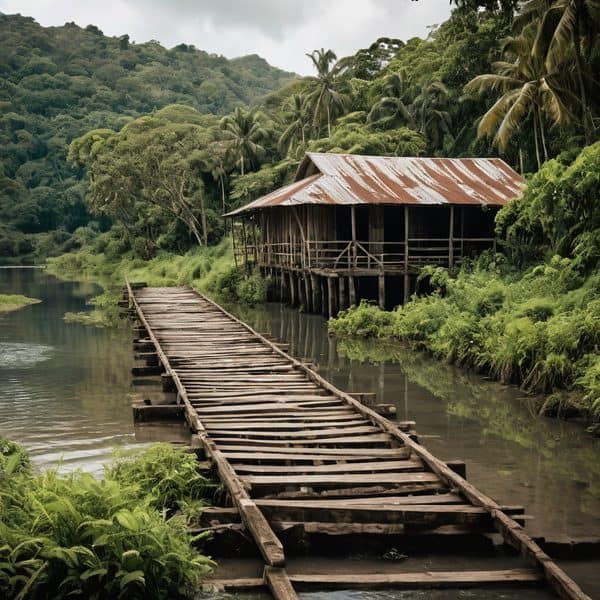
Delanasau — literally “on top of a hill” in Fijian — emerges in a new family history as one of Vanua Levu’s early and surprisingly self-contained plantation communities, shaped by commercial ambition, river transport and a single family’s long tenure. New details in James Norman Stevenson’s book The View from Delanasau: The Life and Times of Leslie Norman Anderson flesh out the estate’s origins, infrastructure and the Anderson family’s dramatic relocation to the property in 1912.
Stevenson records that Delanasau dates back to the early 1860s and was commercially established in 1869 when pioneer planter Robert Langley Holmes purchased and developed about 300 acres along the Lekutu River into a copra estate. The river proved vital: it served as the plantation’s “natural highway,” allowing produce and supplies to move by boat and positioning Delanasau within the wider copra trade that linked northern Vanua Levu to coastal markets.
The estate was equipped for production and isolation alike. Stevenson describes a wharf for loading cargo, copra drying sheds and a wire suspension bridge that spanned the Lekutu to the neighbouring headland of Vatu Colo. Delanasau also sustained crops and livestock on-site and relied on a mix of labour drawn from local Fijian communities and workers recruited from the Solomon Islands, creating a workforce that kept the plantation running year-round.
Leslie Norman Anderson (LNA) entered that established world in 1912, when he and his family took over from Holmes. Stevenson provides a vivid account of the family’s migration from Suva: they boarded an inter-island vessel on a regular coastal route that called at Levuka, Nabouwalu Government Station and Macuwatu before reaching Labasa. The voyage carried not only cargo — copra was loaded for return trips — but the Andersons’ entire household: “10 years’ worth of belongings,” Stevenson writes, including a carefully crated piano supervised during loading.
The approach into Bua Bay and up the Lekutu is described in minute detail. The vessel rounded a headland known to locals as Nia Vaka — “a pig’s head” in appearance — then crossed the river bar at dawn and made the inland run to Delanasau’s wharf. Holmes himself, Stevenson says, remained to oversee the handover alongside the plantation overseer Jonsen and a small team of workers. The arrival unfolded like a procession: the piano and furniture were transferred onto a copra cart, goods were carried by labourers and the family moved inland on a bull-drawn cart, a scene Stevenson likens to a safari.
The book also notes practical changes that followed: within a decade the wharf began to suffer from silting, forcing cargo transfers to longboats — a reminder of how the landscape shaped operational life on remote plantations. Once settled, the Andersons made Delanasau their home for 35 years. Stevenson highlights Hilda Anderson’s role in steadifying the household and credits LNA with reshaping the estate to suit his family’s needs while maintaining its commercial function.
Taken together, the new material paints Delanasau as more than a colonial-era copra site: it was a functioning, evolving community with distinctive infrastructure, a mixed labour regime and a settled family life that bridged urban Suva and remote Bua. Stevenson’s account adds texture to the history of northern plantation life, documenting the material culture, transport routes and human stories that underpinned Fiji’s copra economy in the late 19th and early 20th centuries.