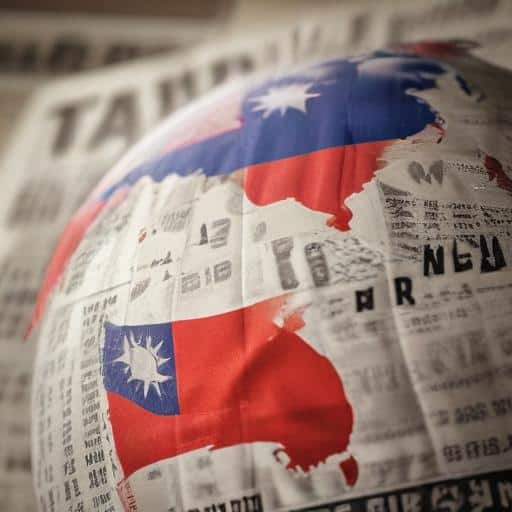
China has issued a pointed criticism of French President Emmanuel Macron’s remarks linking the defense of Ukraine to the situation regarding Taiwan. During a speech at the Shangri-La Dialogue in Singapore, Macron cautioned that unrestrained Russian aggression in Ukraine could signal similar threats to Taiwan. In response, China’s embassy in Singapore labeled this comparison a “double standard,” asserting that Taiwan is a domestic issue for China that should not be compared to Ukraine.
The embassy’s statement, while not specifically naming Macron, included imagery of him and firmly rejected any equivalence between the two geopolitical situations. This response comes in the context of China’s ongoing insistence on its sovereignty over Taiwan, which it considers a province, while Taiwan continues to advocate for its self-determination.
At the same Shangri-La Dialogue event, U.S. Defense Secretary Pete Hegseth described China as an “imminent” threat, warning that any maneuver to invade Taiwan could have far-reaching global consequences. These remarks reflected the increasingly tense atmosphere surrounding Taiwan, where fears of military escalation persist.
This latest development echoes earlier tensions noted in similar contexts. For instance, the Chinese Ambassador to Fiji recently emphasized that Taiwan remains an inseparable part of China, reiterating that the one-China principle is a non-negotiable cornerstone of China’s national policy. Concerns about foreign interference in Taiwan’s affairs resonate strongly within China’s diplomatic narratives, as seen in their consistent opposition to any actions that suggest Taiwanese independence.
With geopolitical complexities deepening, there lies a hope for meaningful dialogue and cooperation among nations in the Asia-Pacific region. It is essential for all parties involved to engage constructively to avoid miscalculations that could lead to conflict. Emphasizing diplomacy and understanding rather than division could pave the way for a more stable international environment concerning issues of sovereignty and regional security.
Leave a comment